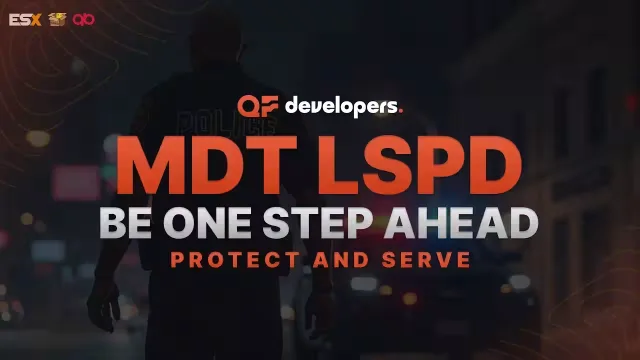
Free Police MDT with Warrants and Fines
FREE
Free police MDT that runs at 0.0ms with a searchable citizen database
Instant digital delivery
FiveM script
QFDevelopers focuses on police and dispatch tooling for FiveM roleplay, headlined by a free MDT that handles warrants, fines and a searchable citizen database. The work runs on ESX, QBCore and Qbox, so most RP servers can install it without rewriting their framework layer.
Open any script for the current price, framework compatibility, dependencies and the creator's own requirements.
1 SCRIPTQFDevelopers makes law enforcement tooling for FiveM, and the flagship is a police MDT you can download for free. It is the kind of resource a server actually needs on day one, not a demo. Officers get a mobile data terminal that pulls up citizens, logs warrants, issues fines and searches a shared database, which means your PD roleplay stops living in Discord messages and moves in-game where it belongs.
The reason this creator is worth a look is simple. Most free MDTs are stripped, half-finished or locked behind a paid "pro" version that does the parts you care about. QFDevelopers put warrants, fines and the database into the free build, so a new server can stand up a working police department without a budget line for it.
The MDT is the centerpiece. Warrants let officers flag a citizen, attach a reason and keep that record visible to the rest of the department, so a traffic stop can surface an active warrant instead of a blank slate. Fines write against the citizen record and give your PD a paper trail, which matters when players contest a charge. The database ties it together as a searchable record officers can pull during a scene.
The style leans practical over flashy. This is tooling built by someone who has sat in a dispatch seat and wanted fewer clicks between a plate lookup and a charge. The naming tells you the priority too. "FREE MDT for Police | Warrants Fines Database" is a feature list, not a slogan, and that is roughly how the resource behaves once it is installed.
Because the MDT is free and open to configure, it works well as a base layer. Smaller servers run it as-is. Larger servers treat it as a starting point they extend with their own charge codes, department ranks and dispatch flow. Either way you are not fighting escrow to change how your own PD works.
The MDT targets the three frameworks that cover most of the scene: ESX, QBCore and Qbox. If your server runs one of those, you are inside the supported path and the citizen data, jobs and player identifiers line up with what the MDT expects.
Install follows the standard FiveM pattern. Drop the resource into your resources folder, add the ensure line to your server config, run any SQL the resource ships for the warrants and fines tables, and set the framework option so it talks to your ESX, QBCore or Qbox core. Restart, assign the police job, and the terminal is live. There is no obfuscation to work around on a free release, so config edits and framework tweaks are things you can actually read and change.
One practical note for new admins: check that your police job name in the config matches the job name in your framework, and confirm the database tables created before you go live. Those two steps cover most of the "it opened but nothing saved" reports on any MDT.
Buy is the wrong word for the headline product, since the MDT is free, and that is the point. You get a real police terminal with warrants, fines and a searchable database at no cost, on ESX, QBCore or Qbox, with an instant download. For a server owner watching every dollar of hosting, a free MDT that does the core job is rare.
Having it on this page means you get the resource with clear framework compatibility spelled out and the download in one place, instead of hunting through a forum thread for a working link. If QFDevelopers ships more police and roleplay tooling in the same style, this is where to track it, since the catalog is organized around the creator rather than scattered across posts.
If you run an RP server and your police department is still handling warrants and fines by hand, this is the low-risk fix. Install it, point it at your framework, and let officers work inside the game. That is the whole pitch, and for a free release it is a strong one.
Answers specific to this creator and how their scripts work.
Yes. The MDT for Police is a free download, and it includes the core features rather than gating them behind a paid tier. You get warrants, fines and a searchable database in the free build.
It targets ESX, QBCore and Qbox, which covers most FiveM roleplay servers. You set the framework in the config so the terminal reads the correct citizen and job data. If you run one of these three, you are on the supported path.
Officers can look up citizens, log warrants, issue fines and search a shared database during a scene. Warrants stay visible to the department, and fines write against the citizen record so charges leave a trail. It moves police roleplay in-game instead of into Discord.
Drop the resource into your resources folder, add the ensure line to your server config, and run any SQL it ships for the warrants and fines tables. Set the framework option to ESX, QBCore or Qbox, restart, and assign the police job. The terminal is live after the restart.
Confirm the police job name in the config matches the job name in your framework, and verify the SQL tables were created. Those two issues cause most save problems on any MDT. Once the job and tables line up, warrants and fines persist correctly.
Yes. It is a free release without escrow obfuscation, so you can read and change the config and framework logic. Many servers run it as-is, while larger ones extend it with custom charge codes and department ranks.
Browse more creators and the FiveM scripts they currently have on sale.